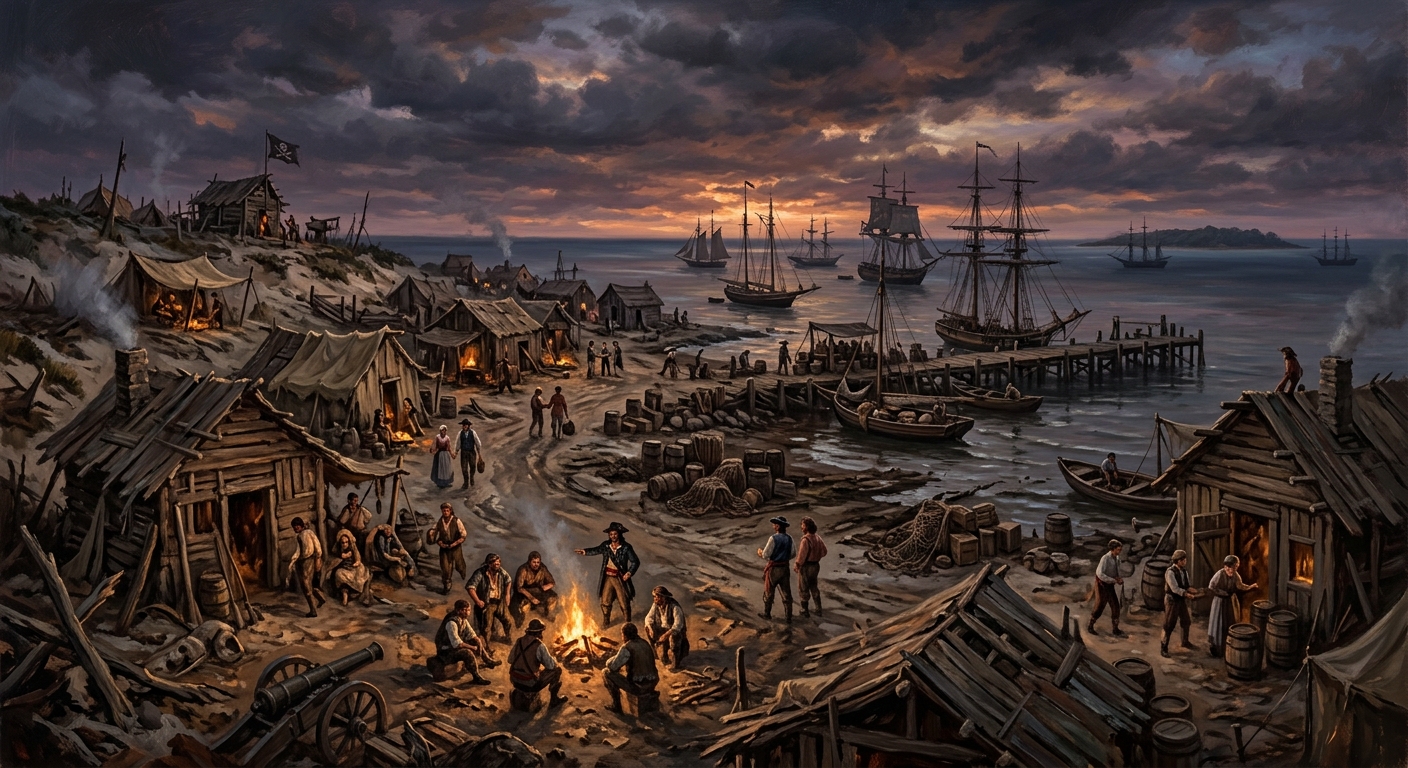
Beneath the grand Victorian facades and the whispers of Gilded Age fortunes, Galveston Island guards a wilder, more lawless past. Before it became the opulent ‘Wall Street of the Southwest,’ this barrier island was a notorious lair for buccaneers, a haven where fortunes were made and lost by the sword. We invite you to peel back the layers and uncover the true story of pirates on Galveston Island, a chapter often shrouded in mist and legend.
The name Jean Lafitte echoes through Galveston’s early 19th-century history like a phantom ship in the fog. This enigmatic figure, a master of both charm and ruthlessness, established his infamous colony, Campeche, on the island around 1817. Here, under the guise of privateering during various conflicts, Lafitte and his Baratarian brethren transformed Galveston into a bustling, if illicit, port. His operations were vast, a network of smuggling and trade that defied colonial powers and laid a gritty foundation for the island’s future.
The island became a strategic base, a place where captured goods from Spanish vessels were brought ashore and traded, often for a fraction of their true value. This era was less about buried treasure chests and more about the brutal realities of a frontier economy, fueled by contraband and the constant threat of naval intervention. Lafitte ruled with a pragmatic hand, creating a semblance of order in his lawless domain.

A Pirate’s Legacy
Lafitte’s reign on Galveston Island was not destined to last. As the United States asserted greater control over its Gulf Coast territories, the pressure on his operation mounted. In 1821, facing an ultimatum from the U.S. Navy, Lafitte reportedly burned his settlement to the ground before sailing away into legend. His departure marked the end of Galveston’s overt pirate era, but not the end of its mysterious allure.
The whispers of Lafitte’s presence, however, linger. Tales of buried treasure — gold doubloons and silver pieces of eight hidden beneath ancient oaks or within forgotten cisterns — continue to captivate. While concrete evidence remains elusive, these stories add a rich layer of intrigue to Galveston’s already complex narrative, blurring the lines between historical fact and captivating folklore.
Echoes in the Strand
Though the grand Victorian buildings of the Strand Historic District rose decades after Lafitte’s departure, the spirit of ambition, risk, and clandestine dealings that defined the pirate era never truly vanished. The early merchants and entrepreneurs who built Galveston into the ‘Wall Street of the Southwest’ inherited an island forged in the crucible of frontier grit. The same waters that carried Lafitte’s schooners later brought the ships of legitimate commerce, but the island’s independent, often defiant, spirit remained.
Exploring the historic Strand today, one can almost sense the echoes of those earlier, wilder times. The district, famous for its survival of the devastating 1900 Storm and its pivotal role in Juneteenth history, also holds within its foundational layers the memory of a time when the rules were written by those with the strongest hand. It’s a reminder that Galveston’s prosperity was built not just on grand visions but on a foundation of raw, unvarnished history.

The saga of pirates on Galveston Island is just one thread in the rich tapestry of stories waiting to be unmasked. From the Gilded Age secrets behind opulent mansions to the cryptic symbols etched into sacred architecture, Galveston’s past is a labyrinth of intrigue. If you’re ready to delve deeper into the island’s true character, to explore its contrasting tales of grandeur and grit, join us. Discover the hidden histories and untold narratives that shape this unique island on a Secrets of the Strand walking tour.
Leave a Reply